Statistical Physics · Tribology
Why Friction Breaks Averaging
Bulk thermodynamics and heat propagation succeed because coarse-graining washes microscopic chaos into smooth, memoryless laws. Dry friction breaks all five mathematical assumptions that make that averaging work.
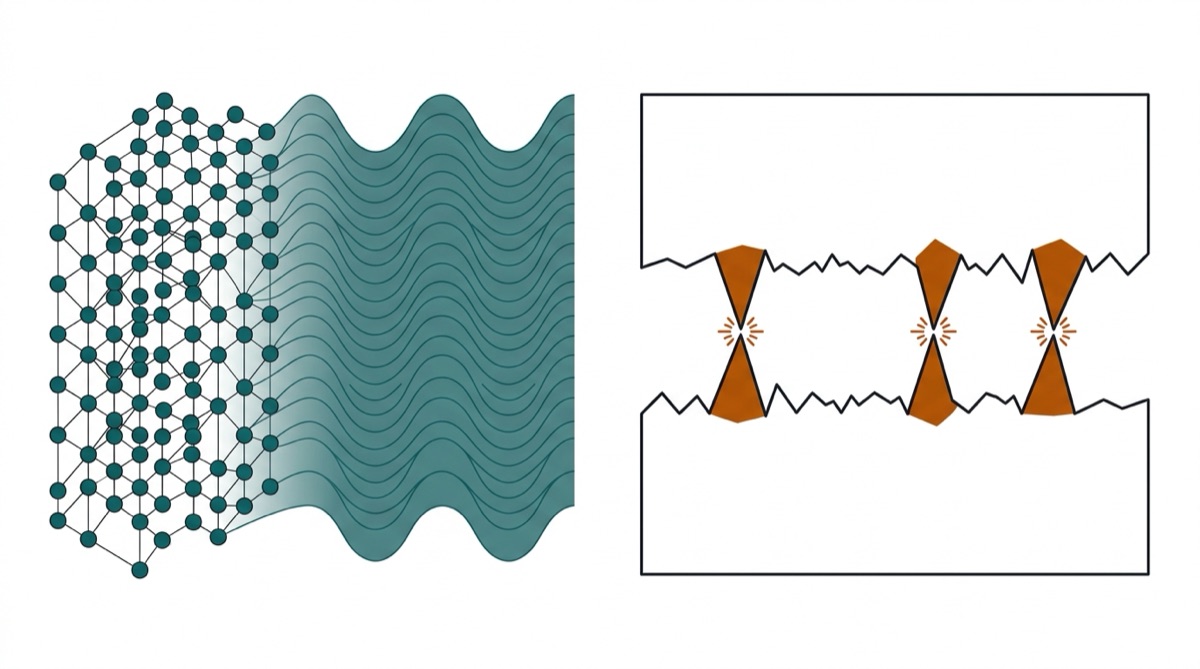
Every pillar of coarse-graining flips sign at a sliding interface
| Pattern | Assumption | Bulk Heat & Thermo | Dry Friction |
|---|---|---|---|
| Statistics | Central limit over volume | Extreme values on 0.1% peaks | |
| Regime | Linear response near balance | Bond snap & stick-slip bursts | |
| Scales | Clean atomic-to-macro cutoff | nm, μm, and cm coupled live | |
| History | Markovian (state-only) | Aging creep & permanent wear | |
| Spatial dynamics | Exponential smoothing | Threshold rupture fronts |
Bulk averages wash out defects — friction amplifies the tallest 0.1%
Heat conduction averages over roughly \(10^{23}\) atoms inside a three-dimensional volume. Under the Central Limit Theorem, isolated crystal defects or surface impurities cancel out into a single stable material constant: thermal conductivity \(k\).
Dry friction happens only at the tallest asperity peaks—often around one thousandth of the apparent contact area, governed by the material hardness \(H\). Because the real contact area obeys \(A_{\text{real}} \ll A_{\text{app}}\), microscopic outliers like surface oxides and adsorbed water layers become the entire signal rather than ignorable noise.
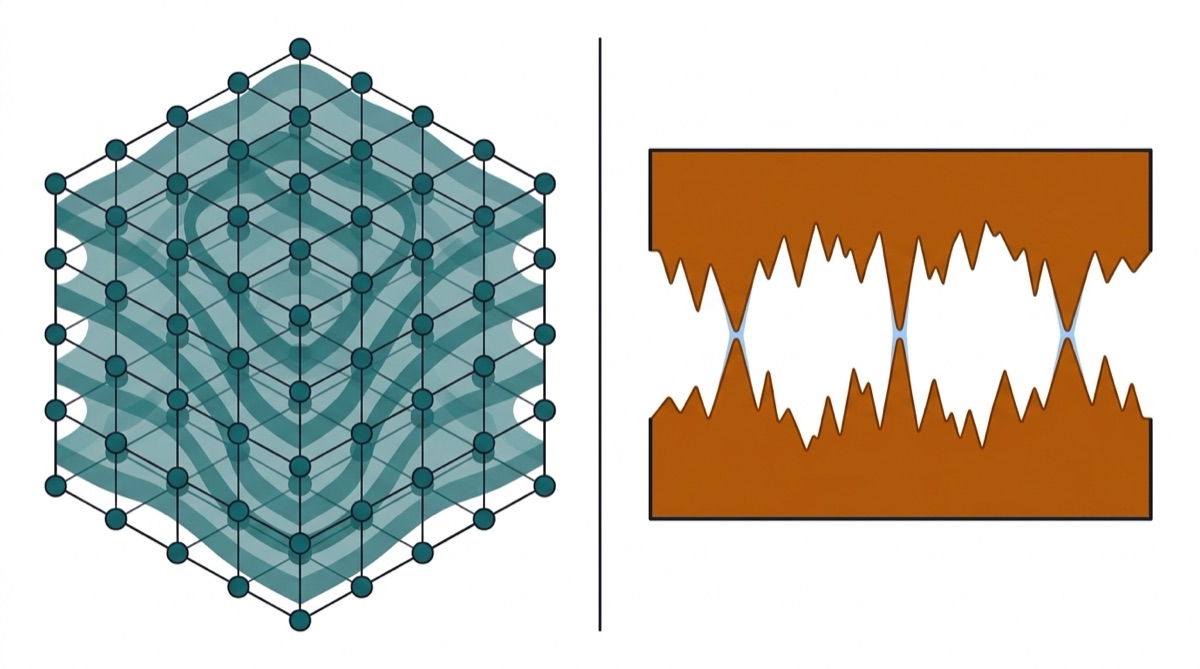
Explore the 0.1% contact bottleneck
Heat relaxes linearly — dry friction snaps far from equilibrium
Fourier’s law is a gentle linear-response law: perturb a solid slightly away from thermal equilibrium and the heat flux relaxes smoothly in proportion to the temperature gradient.
Dry sliding is inherently violent and nonlinear. Micro-junctions undergo plastic yield, adhesive bonds stretch and snap, and sudden stick-slip instabilities dump stored elastic energy into bursts of heat.
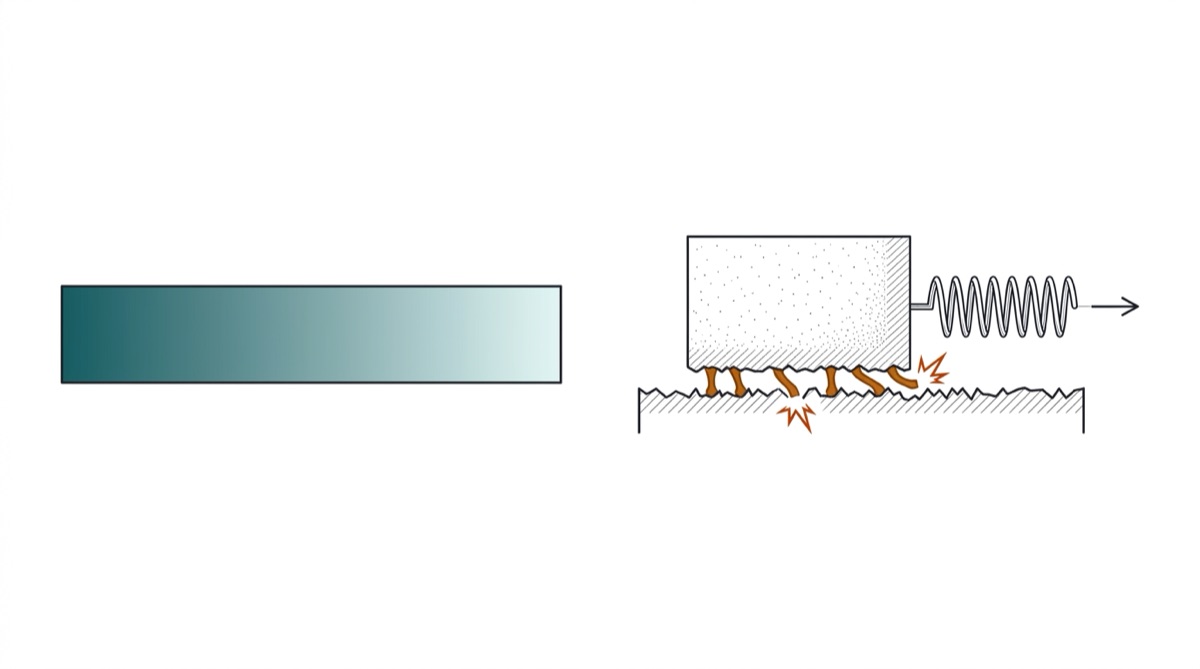
Clean scale separation fails when nanometers drive centimeters
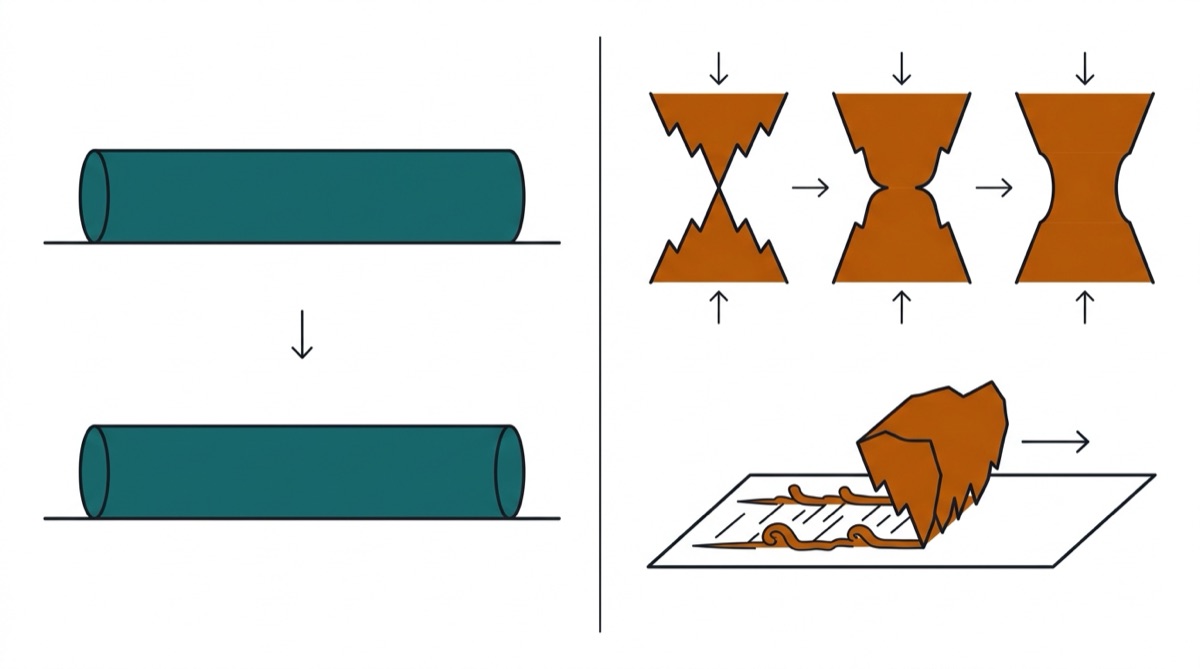
Thermodynamics cleanly decouples atomic vibration times (picoseconds) from macroscopic temperature evolution (seconds). You can integrate out small-scale motion once and never look down again.
Friction locks seven orders of magnitude together simultaneously. Atomic stick-slip at the nanometer scale feeds asperity creep and wear at micrometers, while macroscopic geometry sends centimeter-scale elastic stress waves right back into the contact junctions.
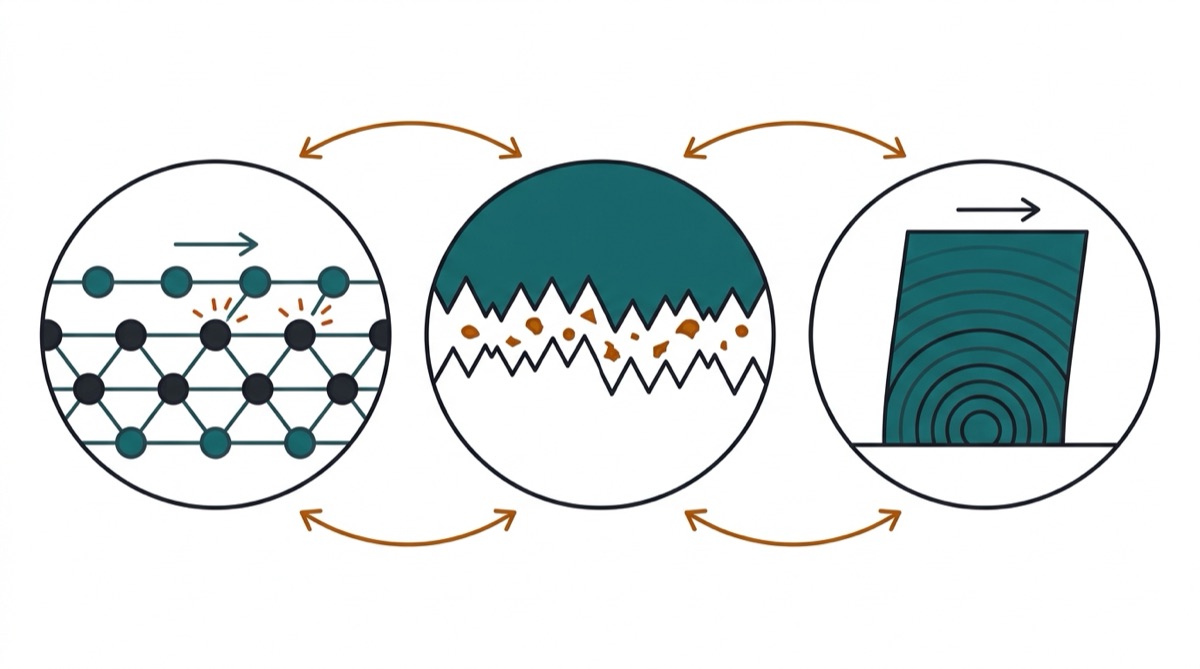
Friction remembers how long it waited and how it slid
A metal rod conducting heat is memoryless: once its temperature distribution is set, it never cares whether it sat idle on a bench for five seconds or five years yesterday.
An interface keeps two physical clocks. Static resting time lets highly stressed asperities plastically creep and weld stronger (Dieterich logarithmic aging), while past sliding permanently reshapes the topography through wear grooves and debris.
Diffusion smooths fluctuations — friction nucleates rupture fronts
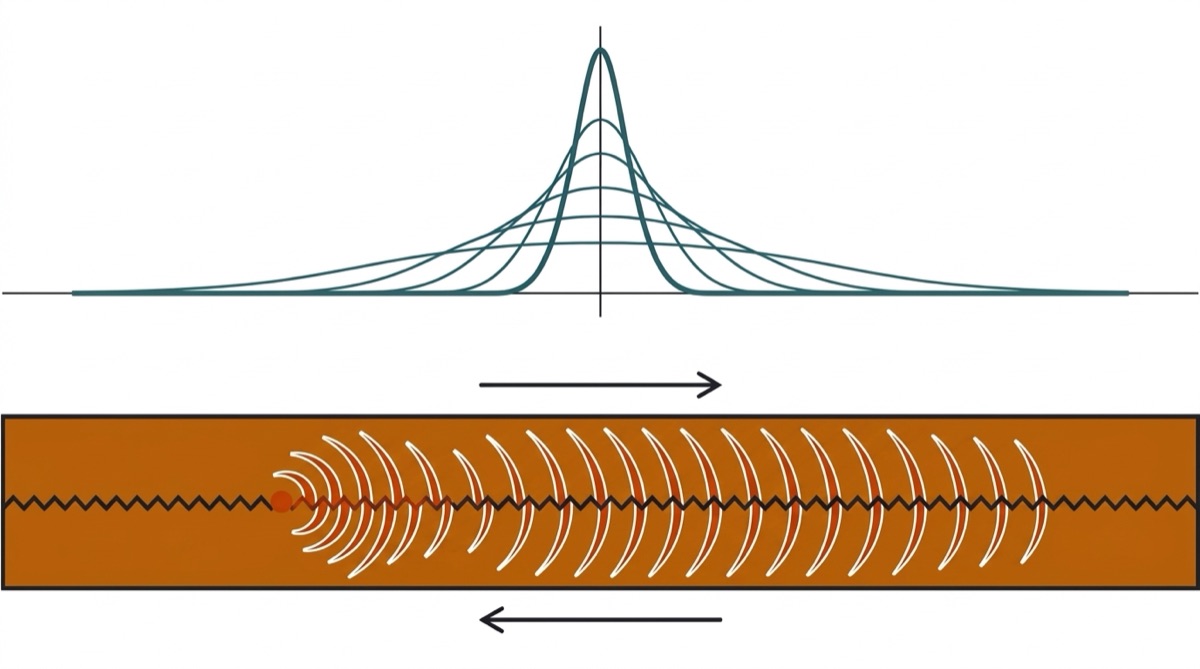
The heat equation is a smoothing operator: sharp local hot spots spread outward and decay exponentially until gradients vanish across the material.
Friction behaves like fracture mechanics and earthquakes. When local shear reaches threshold \(\tau_c\), a tiny slip patch redistributes stress onto its neighbors and can nucleate a runaway rupture front across the entire interface.
Feel the difference: stick-slip aging vs. rupture nucleation
Click Hold & Age (+3 s) to pause sliding and watch stationary contact creep raise the static breakaway peak.
Why Coulomb’s law is an engineering shortcut, not a transport law
Amontons–Coulomb friction (\(F_f \le \mu F_N\)) survives not because microscopic physics averages cleanly into \(\mu\), but because proportional load-area growth roughly offsets shear stress across common materials under steady conditions.
Whenever precision control, humidity, wear, or startup timing matters, that shortcut collapses—exposing the extreme-value peaks, coupled length scales, aging history, and rupture fronts underneath.
References & Foundational Papers
- Bowden, F. P. & Tabor, D. (1950). The Friction and Lubrication of Solids. Oxford University Press (real contact area \(A_{\text{real}} \approx F_N / H\)).
- Burridge, R. & Knopoff, L. (1967). Model and theoretical seismicity. Bulletin of the Seismological Society of America, 57(3), 341–371.
- Dieterich, J. H. (1979). Modeling of rock friction: 1. Experimental results and constitutive equations. J. Geophys. Res., 84(B5), 2161–2168 (logarithmic contact aging).
- Ruina, A. (1983). Slip instability and state variable friction laws. J. Geophys. Res., 88(B12), 10359–10370.
- Rubinstein, S. M., Cohen, G. & Fineberg, J. (2004). Detachment fronts and the onset of dynamic friction. Nature, 430, 1005–1009.
- Müser, M. H. et al. (2017). Meeting the Contact-Mechanics Challenge. Tribology Letters, 65, 118 (multiscale roughness & extreme-value contact).